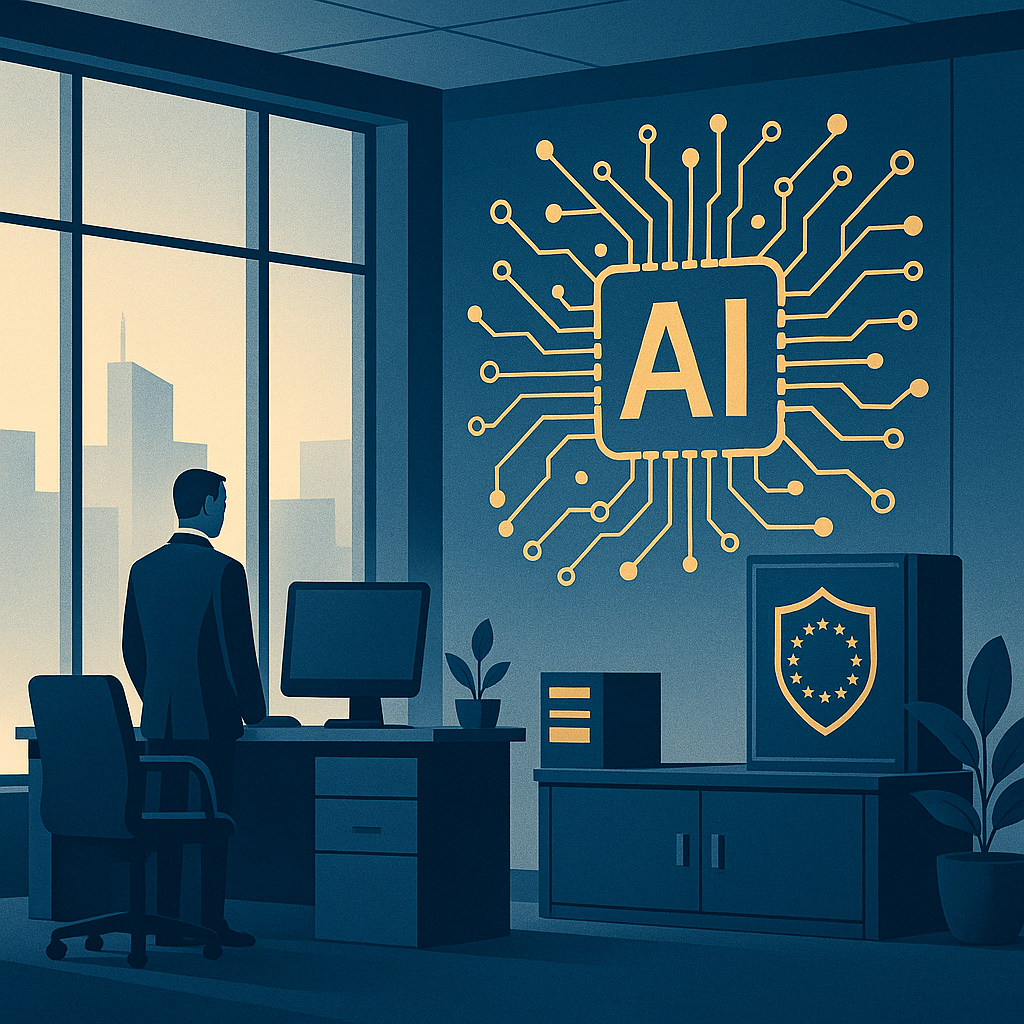
Employee AI Usage Oversight: A Practical Guide for EU Firms
Across Europe, employees are quietly adopting AI tools faster than their employers can govern them. From drafting emails with generative AI to running customer data through automated analytics platforms, AI has entered the workplace through the back door.
For business owners and compliance leaders, this creates a serious blind spot. The EU AI Act now demands structured oversight of how AI is used inside your organisation. Failing to act exposes your company to legal, financial and reputational risk.
This guide explains how to establish effective employee AI usage oversight that satisfies regulators and protects your business.
Why Employee AI Usage Has Become a Compliance Priority
The EU AI Act introduces obligations around transparency, risk management and human oversight. But these obligations do not only apply to AI systems you build or buy formally. They also apply to how your staff actually use AI in daily operations.
The phenomenon of “shadow AI” — employees using unauthorised AI tools without approval — is now one of the biggest governance challenges facing European companies.
Common Real-World Examples
- A marketing employee pastes confidential product roadmaps into a public chatbot to generate copy.
- An HR manager uses an AI screening tool that may qualify as a high-risk AI system under the Act.
- A finance team relies on AI-generated forecasts without verifying accuracy or documenting the process.
- A sales rep uploads customer contact lists into an unvetted AI sales assistant, breaching GDPR.
Each of these scenarios carries regulatory and operational consequences.
The Key Risks of Uncontrolled AI Use
Before designing controls, leaders must understand what is at stake. Unmanaged employee AI usage creates several layered risks.
1. Data Protection and Confidentiality Risk
Sensitive personal data, trade secrets and client information can leak into third-party AI systems, breaching GDPR and confidentiality agreements.
2. High-Risk AI Exposure
Tools used in hiring, credit scoring, or worker management may fall under high-risk categories, triggering strict obligations your business may not even know it has assumed.
3. Accuracy and Accountability Risk
AI outputs can be wrong, biased or fabricated. Without oversight, flawed AI decisions become business decisions — with your company held accountable.
4. AI Literacy Gaps
The EU AI Act requires that staff have an appropriate level of AI literacy. Employees who do not understand AI limitations create compliance exposure.
Governance Controls Every European Business Should Implement
Effective oversight does not mean banning AI. It means governing it intelligently. The following controls form the backbone of a compliant approach.
Establish a Clear AI Usage Policy
Your AI policy should define what is allowed, what is prohibited, and which tools are approved. It must be written in plain language and communicated across the organisation.
- List approved and prohibited AI tools.
- Define rules for handling personal and confidential data.
- Specify when human review of AI output is mandatory.
- Clarify accountability for AI-assisted decisions.
Maintain an AI Inventory
You cannot govern what you cannot see. Create a register of every AI tool used across departments, including the purpose, data involved, and risk classification.
Implement Human Oversight
For higher-risk uses, ensure a qualified human reviews and can override AI outputs. Document who is responsible for oversight in each business function.
Deliver AI Literacy Training
Train employees to understand how AI works, where it fails, and how to use it responsibly. Tailor training to roles — a recruiter needs different knowledge than a developer.
Documentation Requirements You Cannot Ignore
Documentation is the evidence that proves your governance is real. EU regulators and auditors will expect to see it.
Core Documents to Maintain
- AI Usage Policy — your formal rulebook for employee AI use.
- AI System Inventory — a live record of all AI in operation.
- Risk Assessments — documented analysis for each significant AI use case.
- Training Records — proof of AI literacy efforts.
- Oversight Logs — records of human review and decisions.
- Vendor Documentation — evidence of AI procurement and vendor risk checks.
These records also strengthen your position during any AI audit, demonstrating proactive accountability.
A Practical Oversight Framework
To make this manageable, structure your oversight around a simple, repeatable cycle.
Step 1: Discover
Survey teams to uncover which AI tools are actually being used, including informal ones.
Step 2: Classify
Assess each tool by risk level and check whether it touches high-risk activities under the EU AI Act.
Step 3: Control
Apply policies, approvals and human oversight proportionate to the risk identified.
Step 4: Monitor
Review usage regularly, update your inventory, and refresh training as tools evolve.
Example: A Mid-Sized European Firm Gets It Right
Consider a 200-person logistics company in Portugal. Employees were using various AI assistants without guidance. Leadership introduced a clear AI policy, built a tool inventory, and required human review for any AI used in scheduling and hiring.
Within three months, the company had eliminated unsafe data sharing, documented its AI use, and could confidently respond to client and regulatory questions. Oversight turned a hidden liability into a competitive advantage.
Turning Oversight Into Business Value
Employee AI usage oversight is not just a compliance burden. Done well, it builds trust with customers, reassures investors, and enables your teams to use AI safely and productively.
Businesses that govern AI proactively will move faster and with more confidence than competitors paralysed by uncertainty.
Take Control of AI in Your Workplace
The EU AI Act is now a reality, and employee AI usage is squarely within its scope. The time to act is before an incident or audit forces your hand.
Start by building clear policies, documenting your AI use, and training your people. If you need a structured path to full EU AI Act readiness, expert guidance can dramatically reduce your risk and effort.
Ready to build compliant AI oversight for your business? Visit https://phanabenfi.com/eu-ia-one to get started today.